By Rachel Brunts
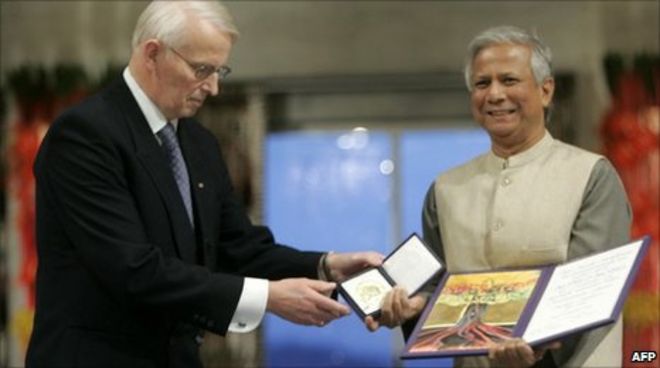
“Microcredit is used to describe small loans granted to low-income individuals that are excluded from the traditional banking system”. Providing credit, savings, insurance, and additional financial services to the poor. (MicroWorld.org) Banerjee and Duflo’s Poor Economics describes the benefits and drawbacks of micro-credits.
When arguing for microcredit, they a line with Dr. Mohammad Yunus, Grameen Bank, microfinance organization model. Yunus defines his mission as a way, “to help the poor families to help themselves to overcome poverty. It is targeted to the poor, particularly poor women.” Moreover, he clearly states microcredit is a human right that is based on ‘trust” versus legal procedures/systems.
From what I gathered from our reading, Banerjee and Duflo are for microcredit in terms of faster return on money, lower interest rates, and offer helpful support groups for members.
To justify microcredits faster return rate on money, the authors discuss a market vendor Jennifer Auma, who uses multiple rotating savings and credit associations (ROSCAs). Speaking towards Auma’s advantages of depositing a small amount of money, the authors wrote, “They don’t have fees, she could make small deposits, and on average she got access to the pot much faster than it would take her if she saved the same amount every week.”(pg. 187) Proving the authors’ stance that this form of credit helps the poor obtain money faster and avoid the costly extra fees.
Furthermore, this example touches on ROSCAs, or “merry-go-round”; which are most popular in Africa. “The ROSCA group was also a good place to ask for advice.” (187) Microcredit is used for more than just simply a savings arrangement, but it’s also a community of people helping one another to achieve their saving goals, and hold each other accountable.
The drawbacks of microcredit consist of banks being strongly against funding them, their foundation is based on trust and promotes bad saving habits.
To begin, “banks don’t like managing small accounts, largely because of the administrative costs of running them.” (pg. 187) Also, governments regulate deposit-taking institutions heavily for fear of works running away with people’s money. (188) Summarizing the authors claims against microcredits erratic funding/fees and apprehension of trustworthiness. However, the book does state that if banks could make accounts more affordable, people, like Jennifer Auma, would be more willing to open a savings account. Lastly, the authors specified that microcredits promote a lack of self–control which leads to bad saving habits. “For example, if you want to reach a goal, joining a ROSCA where the total pot size is exactly enough to achieve that goal is a great option, because once you join, you are committed to contributing a certain amount every week or month, and when you get the pot, you have just enough to buy that thing you have looking forward to buying, and you can do it right away before the money slips through your fingers,” concluding that the lack of self–control is sufficiently serious (196)
I definitely agree with Banerjee and Duflo’s arguments for and against micro-credits and enjoy their take on arguing both sides. However, being born and raised in The United States it is hard to comprehend whether I should be for or against microcredits. I think if I living in Africa I would join at least one ROSCA group because I would love having a community of people to help and support me through that lifestyle.
2)
Microfinance activity in the Republic of Congo began in 1984 with the Central African Economic and Monetary Community(CEMAC) 2007 International Monetary Fund report. In the most recent report, there are 75 microfinance institutions making up 10.5 percent of the financial sector (pg. 62). Ironically, the Republic of Congo is in a very similar situation as described in Poor Economics. An International Monetary Fund book ‘Republic of Congo’ explains that the Congo’s financial sector is underdeveloped because banks charge such high fees for opening accounts. (Pg. 64) Quoting, “the main reasons for high lending costs are lack of competition and the risks associated with the high cost of doing business in Congo.” The Republic of Congo also ranks at the bottom of The World Bank’s Doing Business survey at number 171 out of 175. These findings allow for major micro financial opportunities.
As far as technology, The Consultative Group to Assist the Poor’s FinDev Gateway, stated technology that shifts to instant mobile payments from required personal travel money transfer operators to accounts could double account ownership in Congo. While digital technology has the potential to make a difference in the Republic of Congo, it has a long way to go, microfinancing will be possible with the right policy and technological improvements. As far as eliminating extreme poverty by 2030, under SDG #1, Republic of Congo remains on a list of severely off-track countries (Brookings.edu)

 Case Studies in an Inter/Multicultural World