Blog #5
By Rachel Brunts
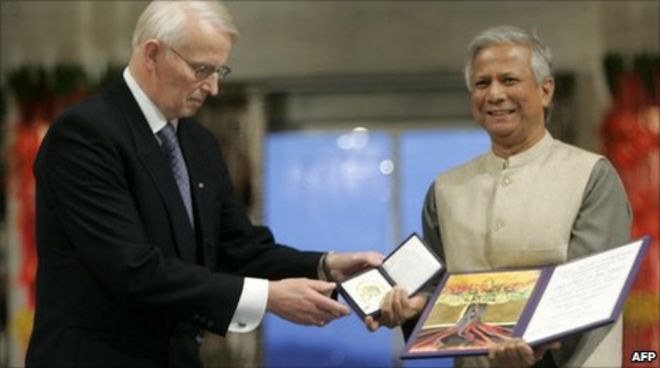
“Microcredit is used to describe small loans granted to low-income individuals that are excluded from the traditional banking system”. Providing credit, savings, insurance, and additional financial services to the poor. (MicroWorld.org) Banerjee and Duflo’s Poor Economics describes the benefits and drawbacks of micro-credits.
When arguing for microcredit, they a line with Dr. Mohammad Yunus, Grameen Bank, microfinance organization model. Yunus defines his mission as a way, “to help the poor families to help themselves to overcome poverty. It is targeted to the poor, particularly poor women.” Moreover, he clearly states microcredit is a human right that is based on ‘trust” versus legal procedures/systems.
From what I gathered from our reading, Banerjee and Duflo are for microcredit in terms of faster return on money, lower interest rates, and offer helpful support groups for members.
To justify microcredits faster return rate on money, the authors discuss a market vendor Jennifer Auma, who uses multiple rotating savings and credit associations (ROSCAs). Speaking towards Auma’s advantages of depositing a small amount of money, the authors wrote, “They don’t have fees, she could make small deposits, and on average she got access to the pot much faster than it would take her if she saved the same amount every week.”(pg. 187) Proving the authors’ stance that this form of credit helps the poor obtain money faster and avoid the costly extra fees.
Furthermore, this example touches on ROSCAs, or “merry-go-round”; which are most popular in Africa. “The ROSCA group was also a good place to ask for advice.” (187) Microcredit is used for more than just simply a savings arrangement, but it’s also a community of people helping one another to achieve their saving goals, and hold each other accountable.
The drawbacks of microcredit consist of banks being strongly against funding them, their foundation is based on trust and promotes bad saving habits.
To begin, “banks don’t like managing small accounts, largely because of the administrative costs of running them.” (pg. 187) Also, governments regulate deposit-taking institutions heavily for fear of works running away with people’s money. (188) Summarizing the authors claims against microcredits erratic funding/fees and apprehension of trustworthiness. However, the book does state that if banks could make accounts more affordable, people, like Jennifer Auma, would be more willing to open a savings account. Lastly, the authors specified that microcredits promote a lack of self–control which leads to bad saving habits. “For example, if you want to reach a goal, joining a ROSCA where the total pot size is exactly enough to achieve that goal is a great option, because once you join, you are committed to contributing a certain amount every week or month, and when you get the pot, you have just enough to buy that thing you have looking forward to buying, and you can do it right away before the money slips through your fingers,” concluding that the lack of self–control is sufficiently serious (196)
I definitely agree with Banerjee and Duflo’s arguments for and against micro-credits and enjoy their take on arguing both sides. However, being born and raised in The United States it is hard to comprehend whether I should be for or against microcredits. I think if I living in Africa I would join at least one ROSCA group because I would love having a community of people to help and support me through that lifestyle.
2)
Microfinance activity in the Republic of Congo began in 1984 with the Central African Economic and Monetary Community(CEMAC) 2007 International Monetary Fund report. In the most recent report, there are 75 microfinance institutions making up 10.5 percent of the financial sector (pg. 62). Ironically, the Republic of Congo is in a very similar situation as described in Poor Economics. An International Monetary Fund book ‘Republic of Congo’ explains that the Congo’s financial sector is underdeveloped because banks charge such high fees for opening accounts. (Pg. 64) Quoting, “the main reasons for high lending costs are lack of competition and the risks associated with the high cost of doing business in Congo.” The Republic of Congo also ranks at the bottom of The World Bank’s Doing Business survey at number 171 out of 175. These findings allow for major micro financial opportunities.
As far as technology, The Consultative Group to Assist the Poor’s FinDev Gateway, stated technology that shifts to instant mobile payments from required personal travel money transfer operators to accounts could double account ownership in Congo. While digital technology has the potential to make a difference in the Republic of Congo, it has a long way to go, microfinancing will be possible with the right policy and technological improvements. As far as eliminating extreme poverty by 2030, under SDG #1, Republic of Congo remains on a list of severely off-track countries (Brookings.edu)
Blog #1
Jacqueline Novogratz defines poverty, within her TED talk ‘Invest in Africa’s own solutions’, through her personal experiences throughout her whole life. I was shocked to hear her interaction with the young boy wearing her sweater she gave to Goodwill, but personally I did not enjoy her TED talk as much as I enjoyed Mia Birdsong’s TED Talk ‘The Story we tell about poverty isn’t true’. Although Novogratz did provide a respectable answer for solving poverty, stating that we need to, “Build viable systems on the ground that deliver critical and affordable goods and services to the poor”. Counteracting most Americans views of just simply donating money, and implying that we need a more hands-on approach to end poverty in Africa. I believe her main message to the audience was that we need to stop looking at Africa and other poor countries as, “them”, and start referring to them as, “us”. Overall I thought Novogratz’s TED talk was good, but personally not as impactful to me.
As stated in the United Nations Development Programme article, ‘Sustainable Development Goals’, the SDGs are, “a universal call to action to end poverty, protect the planet and ensure that all people enjoy peace and prosperity. I believe the vision/goal of the SDGs is to make our world a cleaner, safer, and more prosperous community by building off MDGs successes. Officially, the ‘2030 Agenda for Sustainable Development’ best summarizes their vision stating, “We can be the first generation to succeed in ending poverty; just as we may be the last to have a chance of saving the planet. The world will be a better place in 2030 if we succeed in our objectives”.
As far as the neo-liberalisms effect on the SDGs, the study, ‘Sustainable Development Goals In the Age of Neoliberalism’ states, “It is more probable that the global trade tilt will be less away from neoliberalism than towards new rules, agreements or simply unilateral actions”.
When John McArthur discusses the, “Players on the Bench”, in ‘Own the Goals’, he is referring to U.S. President George W. Bush and The World Bank. McArthur criticizes these powerful forces as the “players on the bench”, because of their shared failures of inactively participating in the Millennium Development Goals. I believe this characterization to be both humorous and fitting.
President Bush is definitely a player on the bench through his attempted team player attitude to support part of the MDG efforts, yet still refusing to fully submerge himself within the MDG targets; therefore, sitting, “on the bench”. McArthur criticized President Bush’s stands, stating that, “by refusing to directly engage with the MDGs in their early years, the United States missed an opportunity to highlight its contributions to development efforts and foster international goodwill.”
The World Bank also had hesitations supporting MDG. McArthur summarized their initial delay stating, “Early resistance was in part due to bureaucratic resentment of the UN for its having been given such a prominent role on development issues.” Also, this essay explains that The World Bank focuses primarily on economic issues over social issues, such as the MDGs, so personally I understand why McArthur would label The World Bank as, “players on the bench”.
Although, McArthur does still critics The Bank for their stance stating, “the bank, as a main interlocutor with the developing world, should have helped poor countries assess how they could achieve the MDGs and sounded the alarm about donor financing gaps”.
d)
After reading “How to Help Poor Countries” I have learned that more aid money can be both good and bad. Aid money effects poor and rich countries differently depending on their economic system and society. I found it embarrassing to learn that the best way to help poor countries is by letting them help themselves. As the text stated, “help developing countries help themselves, wealthy nations must begin to lift the burdens they impose on the poor.” As an American, I feel as though I have always thought the best way to help the poor is to donate money. After crafting this blog post I have learned eye-opening knowledge on the perception of the less fortunate and their potential.
Some suggestions to help the poor included: business opportunities, individualized economic policy, experimentation, and monitor money loaned appropriately. For example, “How to Help Poor Countries” stated, “The World Bank and other organizations are designing programs with countries in which resources are disbursed not in exchange for policy reform but on the basis of pre-agreed benchmarks of progress”. I agree with the stance of this article and value its viewpoint. There is no perfect formula to solve poverty; we just have to work harder than donating $1 to Haiti, at the grocery store checkout line, if we truly want to make an impact.
Blog #2
BY RACHEL BRUNTS
A.
Good news can be classified in many ways. Especially when emphasizing the factors that generate good news the answer becomes more challenging and possibly arguable. I believe Steven Radelet in Emerging Africa – How 17 Countries are Leading the Way describes Africa’s past historical events (good and bad) as the factors leading to good news in Africa. More specifically, the factors of the economic crisis, political protests, and government reform to democracy. While not all of these events are positive factors in Africa, they all can be classified as good news in Africa.
For example, Radelet’s Chapter 2, he explains the detailed snowball effect starting during the austerity of Africa’s government and the economic crisis. Creating a peak in political protests in 1991; which pushed a government response in 1992 reforming civil liberties. Thereafter, leading to competitive political elections and African governments soon began to allow greater political rights. All in all, resulting in democracy.
I believe these factors to be the turning point for positive growth in Africa. It a little funny to state that I would classify the complete and udder downfall of the African society would be such good news, but I believe it. Since the austerity government had nothing due to bankruptcy, they had no power over the people. Radelet quotes, “Authoritarian governments appear to have fallen not because they face more unrest but because they were unable to respond to it”. This lack of democratized power allowed counties to make their own choices and if ran responsibly, let their people live freely.
B.
Millennium Villages Project describes that “The Millennium Villages are proving that by fighting poverty at the village level through community-led development, rural Africa can achieve the Millennium Development Goals.” Also, the project suggests, “Simple solutions like providing high-yield seeds, fertilizers, medicines, drinking wells, and materials to build school rooms and clinics are effectively combating extreme poverty and nourishing communities into a new age of health and opportunity”. The article also states that the Millennium Villages support 14 sites within 10 countries for 500,000 people.
Supporting the Millennium Village Project, Jeffrey Sachs stated in The Age of Sustainable Development, “Eradicating poverty is the greatest global challenge facing the world today and an indispensable requirement for sustainable development”. (pg.483)
In retrospective, a Foreign Affairs article reviews Sachs book stating, “It addresses the complicated challenge of assuring a continued rise in prosperity, particularly in the remaining poor parts of the world, while avoiding roadblocks such as the depletion of fresh water, extensive air and water pollution, the loss of biodiversity, and excessive climate change.” Overall, defining his writing as a logical yet simple examination of poverty centering the greatest global challenge.
Millennium Villages
Each individual link correlates to the source used for the given information that follows
- Why was that particular village chosen?
Tanzania: MV of Mbola and a new site AngloGold Ashanti (AGA); I picked this village because it has multiple MVP sites and I wanted to compare it to a single existing site.
Uganda: MV of Ruhiira; I picked this village because it is an existing MVP site and think it would be interesting to compare two divers villages.
2. What is the goal for that village?
Tanzania: Eradicate extreme poverty and hunger, Achieve universal primary education, promote gender equality and empower women, lower child mortality, improve maternal health, combat diseases, environmental stability, global development
Uganda: The village is doing well so the goal would be to continue to improve areas they are weaker in. I believe the goal would be to plant more trees on land to help with the firewood shortage. Which should also help lower population density and growth rates,
3. What successes or failures have been recorded?
Tanzania: Successes: Businesses growing, health care centers improving, solar energy and water improvements, school attendance, students surplus, and academic performance increasing. Also, tree nurseries were planted in school to educate students on deforestation.
Failures: overgrazing and agriculture expansion decreasing land production, lack of health and education guidelines, access to antiretrovirals have decreased.
Uganda: Successes: Number of children eating at school has increased dramatically, they were the first site to launch School 2 school program, malaria health conditions are nearly gone, and MVP has improved their water resources.
4. What do the critics say?
Tanzania:
Uganda:
5. Look at the countries’ GDP, GNP, WDI, HDI, etc. to evaluate each village.
Tanzania: GDP:$163bil GNP: $51bil Gini: 37.8(medium) HDI: 0.531 (low,151st) Pop:55,572,201 Area: 55,572,201Water 6.4%
Uganda: GDP: $88bil GNP: $26bil Gini: 41.01 (medium) HDI: 0.493 (low 163rd) Po:p41,487,965 Area: 241,038km Water: 51.39%
6. How are local, national and global issues addressed and involved?
Tanzania: They have a presidential republic. Consisting of a President, Vice President, Prime Minister, Speaker, and Chief Justice, who all address their local, national and global issues cohesively depending on their specific duties.
Uganda: They also have a presidential republic. Consisting of a President, Vice President, and Prime Minister.
7. I think Tanzania and Uganda are both conducting viable projects toward ending poverty. I have always pondered the question on how to end global poverty, but quite honestly thought it was impossible. Educating myself on the Millennium Villages Project and Millennium Development Goals has provided me with an optimistic view, agreeing with Steven Radelet, and more specifically with the future fate of Tanzania and Uganda.
Blog #3 Emerging Africa and Rep. of Congo
By: Rachel Brunts
Part I: Questions on Emerging Africa
a) As explained in Ch. 7 of Emerging Africa, the meaning of a “Cheetah” or the cheetah generation, is a new generation of leaders and entrepreneurs rising, in the early 2000s, to government bureaucracies, civil society, organizations, and businesses. Author Steven Radelet, described this generation as, “Africa’s new generation, a nebulous yet palpable group across the continent that is seeking to redefine Africa through democracy, transparency, and a dynamic private sector, and by fostering strong connections with each other and with the rest of the world.” (126)
Concerning the meaning of a “Big Man” or the hippo generation, were essentially a single man dictatorship in the mid-1980s. Radelet explained in Ch. 2 that, “Governance was dominated by strong-man presidents who faced few constraints on power–other than the threat of violent overthrow – and who could easily ignore inconvenient constitutional restrictions and laws with impunity.” (pg. 50)
The hippo generation and the cheetah generation definitely refer to a different way of looking at democracy and civil society. Cheetah’s people valued and fought for their right to democracy within their government leaders; while the Hippo’s people wanted democracy, but they were suppressed by the power of one individual leader. As far as civil society, the cheetah generation had a fairly similar interest in creating a new Africa by demanding their civil rights. I believe the civil society of the hippo generation always wanted to live in a country with democracy. Although, since the government was so powerful, they were not able to achieve their rightful freedom until their government was either overthrown violently or in some cases bankrupted out of power.
b) Reiterating Radelet’s positive view in Chapter 6 on the African ICT, he states, “Today thanks to the rapid expansion of mobile phones, Internet connections, and other forms of information and communications technology, the opportunities for technology to help lift people out of poverty and change the economic fortune of Africa have never been greater.”(pg. 110) A journal article by the International Journal of Business, Humanities and Technology on
The Impact of Internet on African Education and Culture finds that there are both positive and negative effects the internet processes in terms of education and social networking:
“It is true that the Internet has moved the continent forward by improving it businesses, educational and cultural sections; nevertheless, the halting effects have proven to be detrimental to the region’s educational and cultural aspects. If the region decides to stick to its old norms, then it will lose the benefits that the Internet age has brought.” (76)
I agree with Radelet that information and communication technologies have helped African countries grow stronger. However, at the end of the day, a poverty strikin’ country is no different than any other country; such as the United States. We are all subject to the negative and positive effects technology inevitably brings to any nation. To prove our nations similarities, the journal provided a potential solution to technology in Africa stating, “Adequate awareness about the Internet is crucial. People must be made to understand that the Internet can be a very enlightening platform, fun to surf, as well as damaging to character if inappropriately utilized.” (76)
Part II: explore one country as assigned in class
a) Yes, it is possible to get trapped in poverty. The Economic Times defines poverty traps as, “a spiraling mechanism which forces people to remain poor. It is so binding in itself that it doesn’t allow the poor people to escape it.” As described in Banerjee & Duflo’s Chapter 1, “There will be a poverty trap whenever the scope for growing income or wealth at a very fast rate is limited for those who have too little to invest but expands dramatically for those who can invest a bit more.” (pg.11) Found within the Republic of Congo Poverty Assessment Report, poverty traps in the Republic of Congo are present in all areas including geographic region, education, occupation, and household size.
b) Republic of Congo progress of SDG #1
In 2004 50.4% of the population was living below the national poverty line. As of 2011, that percentage dropped just shy of 4% at 46.5%. Personally, I do not see that as much progress toward ending poverty in all its forms.
Trading Economics data on Republic of the Congo GDP per capita PPPwas used to source the following paragraph.
While the Rep. of Congo’s crude oil production increased from 347 to 307 BBL/D/1K in July of 2018 they scored 19 points out of 100 on the 2018 Corruption Perceptions Index, ranking 165th least corrupt nation of 175 countries. Also, their GDP is at -42.80%.
c) Is Human capital an issue in your country?
As defined on the Economic Help blog, “Human Capital is a measure of the skills, education, capacity, and attributes of labor which influence their productive capacity and earning potential.” Human capital is, unfortunately, an in issue in the Republic of Congo. Thankfully, The World Bank stated, the “National Development Plan (2018 to 2022) lays out its intention for a change of focus to improving governance; building human capital, and diversifying the economy.”
Blog Post #4
By Rachel Brunts
Part I:
- Find a ‘cheetah’ in your assigned country (person or organization) and show his/her/its work that helps the country move towards protection of human rights, free speech, systems of accountability, reducing poverty, etc.
Beginning in the early 1990s to present day, the Ntsiloulou rebel group, or the Ninjas, have been fighting back their political/military leader, Denis Sassou Nguesso, led by their respected leader, Frédéric Bintsamou, or Pastor Ntumi.
IRINN article, ‘Congo-Brazzaville’s hidden war’, comments on the level of Ninja knowledge stating, “Very little is known about how they are structured and operate, and how much real control Ntumi exerts at the local level. Bereft of information, the international community has termed them, “armed elements”. To the government, they are simply “terrorists”.
The Ninjas have been fighting back their government mostly by resisting government policy, refusing to participate in pre-rigged elections, and rallying community to peacefully challenge their government officials.
After many years of back and forth conflict in December of 2017, BBC News stated, “The government and the rebel group known as the Ninjas sign a ceasefire deal.” Allowing for a more peaceful environment for trading and overall life.
- Chapter 3 of Radelet’s Emerging Africa talks extensively about democracy building as well as discusses how one defines democracy, what is elemental and how are democracies ranked and judged. How does your country rank? Explore the following sites and answer the questions
Chapter 3 of Radelet’s Emerging Africa, explains that Radelet believes there is no universally accepted definition of democracy but defines democracies as any country that meets the Freedom House and Polity IV standards. Also, he ranks and judges each democracy by their Freedom House civil liberty score (scale 1 to 7, 1 is the best), political rights score, and average Polity IV score (scale -10 to 10, 10 is the best) Pg. 62.
According to the Think Tank Freedom House, the Republic of Congo’s 2017 freedom statue is as labeled, “not free”, ranking #27 in world freedom, on a scale of 100 being most free. More specifically, the Congo’s freedom in the world as, “Freedom Rating 6/7, Political Rights 7/7, Civil Liberties 5/7,” 1= most free and 7= least free.
- What are the dangers that global democracies are facing?
After reading The Washington Post article, I’ve learned that the dangers global democracies are facing are not only occurring in sub-Saharan Africa but right here at home in the United States. As the article says,“the retreat of the United States from global leadership, coupled with the Trump administration’s weak and ambiguous commitment to democratic values at home, raises serious concerns about the near future. As democracy is undermined, the world inevitably becomes a more dangerous place.”
- Is YALI active in your country?
Positively, YALI is active in the Republic of the Congo! A YALI member, Jean Ndongui, founded LEB CONGO, described as, “a nonprofit organization that works to “break the cycle of unemployment among young people in the Republic of the Congo by training them in leadership, entrepreneurship, and business and funding youth projects.”
- What are current news in your country?
The most recent news I found in an AllAfrica article was a soccer game on February 19thof this year. The Republic of the Congo played a game between Zimbabwe, fighting to make the finals. The article discusses how their star player, Mario Balotelli, is most likely going to miss out on the finals due to a serious injury. While this most recent news story may not be that politically meaningful or a life-changing fact, but I am happy I found this news. This story reminds me that the Republic of the Congo is not just a poverty-stricken dictatorship, but the country just like any other. Given, their freedom may not be equal as my own; they still continue their lives in the same manner as the rest of the world, and I believe this article has provided me with a better understanding of my prior perception of the Congo.
Part II:
- What are the major obstacles in raising developing countries out of poverty?
In Poor Economics by Banerjee & Duflo Ch. 6, the major obstacles in raising developing countries out of poverty is, The African ICT Explosion, fueling entrepreneurship and commerce, expanding access to finance, and strengthening health services, democracy, and governance. Thankfully to help within all of these categories this book describes how mobile phones and the internet have transcended poverty-stricken countries toward a better tomorrow. Quoting pg. 122, “These technologies are helping everyday Africans overcome some of the daunting constraints that have inhibited economic growth and poverty reduction in the past, including geographic isolation, weak infrastructure, poor information, and inefficient markets.”
 Case Studies in an Inter/Multicultural World