Blog #11- Islam and the West

By Rachel Brunts

  1. Based on the article, Islam and the West: Narratives of Conflict and Conflict Transformation, discuss the story of intercultural confrontation and intercultural compatibility and how they affect conflict transformation.

In the article, Islam and the West: Narratives of Conflict and Conflict Transformation, Nathan C. Funk and Abdul Aziz Said discuss and compare the Western world and the Middle East. They discuss how the narratives of the two worlds are often portrayed in a polarizing way and almost pitted against each other. The authors don’t think that this polarizing narrative is the right way to go about the discussion on the Western world and the Muslim Middle Eastern cultures. Instead, they suggest a type of narrative where similarities between the two cultures are highlighted in order to stimulate a breakthrough of many of the ideals that have been built that suggest that the two cultures are so vastly opposite.

Funk and Said go on to discuss how neither culture is completely “innocent” in the idea that one culture is the target of the polarization, but rather that both cultures utilize a “self vs. other” ideology with contrasting differences. Both cultures have been found to exaggerate the extreme parts of the other’s culture. For example, in the United States, people think that Islam is directly connected to terrorism and make judgments on people that are a part of the Muslim community unjustly. At the same time, Western culture is often seen by Muslims as a much morally loose society that often portrayed in TV and movies.

I think that the ability to start to see similarities between the two cultures will lead to a progressive dialogue that doesn’t pit one culture against the other. Once the culture are seen less as polar opposites and more for shared values like education and citizen’s well-being, this “self vs. other” ideology will begin to break down.

2. What are the hard decisions about immigration according to Frum that need to be taken in the US. Do you agree? Is there a right level of immigration?

According to David Frum I believe two groups have hard decisions to make in terms of immigration. The first group being the US government as a whole, and secondly native born Americans.

For example, in terms of our government as a whole, Frum explained their hard decision of deciding, “Who should be invited to join with the natives of the United States to build, together, a better life for the Americans of today and tomorrow?” It sounds simple but they truly have to consider what type of people, how many, how old, their education level, their work ethic, and so much more when allowing an individual to legally become a citizen.

Moreover, in terms of born and raised American citizens, Frum stated:

“Americans are entitled to consider carefully whom they will number among themselves. They would be irresponsible not to consider this carefully—because all of these expensive commitments must be built on a deep agreement that all who live inside the borders of the United States count as “ourselves.”

I agree that both the US government and regular citizens do have hard decisions on their hand, and being a US citizen myself it was refreshing to heat Frum include not just the government when dealing with immigration, but showing us that we have a right to a voice as well.

From what I gathered from the article, and within my personal opinion I do not think there is a “right level of immigration”. Frum explained that, “even at lower immigration levels, America will continue to move rapidly toward greater ethnic diversity. Under today’s policies, the U.S. will become majority-minority in about 2044. Basically, immigration will grow no matter how hard the government tries to expanded or downsize this inevitable population growth.
Blog #10- Islam in the United Kingdom

By Rachel Brunts

Describe the historic foundation of the current fundamentalist “jihadi” movement.

  1. Traditionalist “jihadi” movements began in the last 20th century. In 1979 the Islamic Revolution in Iran saw that the Soviet Empire was brought to its knees. This fall of the Soviets brought the emergence of militant jihadis who sought out to create an ideal Islamic State. The Taliban in Afghanistan was an attempt to implement such a vision. These fundamentalist see “the West” and modern elements of Muslim societies as enemies alike. 

What is sharia law? What are the main concerns of puritan fundamentalists when it comes to Islamic law?

  1. Sharia Law is Islamic Law. It is believed by fundamentalist that it is Islamic Law that makes In Islamic State, Islamic. Within sharia law are the hudud laws which are the maximum punishments that can be given for a certain crime, such as cutting off a burglars hands. This is where puritans have their concerns (and rightfully so in my opinion). It is also noted that even the Prophet Mohammed himself discourages the usage of the hudud laws.

Do you think Islamic law has always been consumed with “punishment?” What changed?

  1. No, personally I would not say that the Islamic law is consumed with punishment. Although from my point of view I would say that the fundamentalist who are seeking the ideal Islamic State are consumed with punishment in order to practice the purest form if Islam, but since I am not Islamic it is hard to know if they feel as those they are punished. Other than that I feel like Islamic law is meant more to establish rules that Muslims should follow than to simply reprimand or punish people. I also found it interesting that according to Sardar and Davies, “the sharia owes very little to the Qur’an” (p. 117).

What is the musawah organization about? What does musawah mean? What are some of their key messages? What is your assessment of this association?

  1. Musawah is a global movement for equality and justice in the Muslim community. In Arabic it means equality. Their key principals are equality, non-discrimination of any religion, race, or gender, full and equal citizenship, and to respect others rights and ideals. I think this is a great association, and extremely important for the entire world, Muslim or not, to be aware of and respect. I really think they need to do a better job of spreading awareness about their organization. As a perfect example, if it was not for this class I would not have known about it. Even though I am thankful to have learned about Musawah now, I think all other non-Muslims need to be educated regarding this serious matter. If that can be achieved I think the Muslim community and this organization would greatly benefit.

Post #9-Muslims in Europe

By Rachel Brunts

  1. How do Zemni and Parker (ch.13) explain the “failure of integration” of Muslims in Europe? Why is the way Europeans think about integration and multiculturalism problematic in the discourse surrounding Islam and Muslims in Europe? Explain and give examples.

Zemni and Parker explain that the “failure of integration” of Muslims in Europe lies in the ways in which Islam has been reconstructed in the European discussion as something of an anti-Europe. Sadly, from this point on, ideas of multiculturalism have been rejected and there has been a failure to adopt the styles and practices of daily life which have been considered in sync with the norms of the dominate national cultures.

As far as the problems, Europeans think integration and multiculturalism come from a history of the Islamic “movement.” The real problems that were associated with migrants were now being seen as a consequence of their socio-economic status during decades, and translating into “cultural differences”. The removal of migrant’s nationality, and an additional link to a civilizational and cultural phenomenon, it was easier to make the migrants’ presence a problem without seeming prejudiced.

Islam’s presence in Europe is limited to cultural terms and not in flow of migration, societal discrimination or class politics. This has allowed Islam to be seen as a cultural value that is the more determinant of political behavior. From this, an assumption occurs on migrants, that their cultural origins determine their incapability to meet and respect, the demands and responsibilities in the “secular” European state.

The examples become that the conversation influences, the way European public and policymakers view and interact with Europe’s Muslim communities, and have real consequences for the Muslims as individuals.

The consequences affect how Muslim immigrants/migrants perceive the possibility and desirability of wider civil participation and how this can actually legitimize certain discriminatory practices that put migrants in socially defensive positions.

  • What is your assessment of the Foreign Policy The Dispossessed article and the film My Escape? Does the comic do justice to the refugee situation? Is it a good analysis of the crisis? Does Islam play a role? Even if you only watched a part of the film My Escape what is your assessment of the film? What caught your attention?

From the film My Escape, what really caught my eye was how bold many of the participants were throughout the film. They had many doubts, fears, and anxieties but were never once hesitant to film the injustices among them and the experience, for the world to see. Another thing that stayed in my mind was hearing one of the girls laugh. It was a very quick moment but she laughed at something funny even in her predicament and tough situation.

Moreover, another moment within the film, that caught me off guard was that those who were helping the refugees get across the border behaved more as kidnapers than people of assistance. I had no idea how life threatening this experience would really be and was definitely shocked

I do indeed think the comic does justice to the refugee situation because it details the journey in more terms than just going from point A to point B. There was the talk of price, maps, realities and a clear itinerary that allowed us to really understand the depths that had to be gone thru in order for refugees to make this journey.

I felt most connected to the comic because the visuals are so much more relatable than words on a page. Drawn facial expressions, gloomy colors and cries out to God really put more emotion into the tension of the situations rather than just describing it. Also, I felt more connected to the situation be truly being able to grasp and more easily understand.

The film and the article both really gave viewers an inside into the chaos that the war summoned into many lives. Not only that, but it also allowed us to get an idea of what life once was prior to the war and how Syrians appreciated their home.

Blog Post #8: Muslims in France and The Headscarf 

  1. Explain the historical background of the Muslim presence in France. Why does the Islamic community lag behind both economically and socially in France? Discuss.

Since France needed labor during military conflicts /economic expansion, Muslims first began arriving to France due to underdevelopment and poverty within their home countries. Arriving around the First World War Muslims were immigrated for industrial/ mining purposes, or served in the French military on a “special native unit”. I think the reason the Islamic community lags behind the France both economically and socially steams from their initial immigrating to this society. The book explains that Muslims were not initially planning on staying in France permanently, but inevitably that was the case. Eventually leading the French to see the Muslims as a burden to their society and in the mind of the French as disrespecting their historical religious ideologies. Since the Islamic community was not viewed as to other French citizens, I believe this has led to the economic and social lag in all aspects within France

  • How does the presence of Islam in France cause a challenge to the secular order? Is France’s secularism, or Laïcité, unique? Explain!

Chapter 1 of ‘Islam, Europe’s Second Religion’ describes France’s secularism, or Laïcité as, “morestrict than in other European countries and even has anti-religion dimensions.”  (pg. 3) The book described within its introduction that once Islam became more culturally “visible” in France there was a lot of discomfort and anxiety among Europeans. The Europeans had trouble understanding Muslims dietary differences, the head scarves, and their religious rules. To quote the European uncertainties as, “distasteful and a threat to their cultural identity ad values.” Basically stating that Islam’s pure existence in France challenged the secular order! That is so crazy to me.     

  • Based on your readings and research, why is the headscarf seen by some (many?) as a threat to Western culture?

Based on my readings, research and class discussion, I think the headscarf is seen by some (or many) as a threat to Western culture because of the unknown knowledge of its cultural meaning, symbolization, and/or importance. Conducting my own research, ‘The Conversation’ wrote an article describing three reasons some women wear the headscarf are an expression of identity, to maintain modesty, and for fashionable reasons.

Personally I do not see the headscarf as a threat to Western culture, but it saddens me that not everyone within the Western culture has this same mindset. An Islamic wearing a headscarf is equivalent to a Jewish person wearing a yamcha, or a catholic person wearing a cross. It blows my mind that the Western society would even have to have a conversation about a headscarf being a symbol as a threat to our society.

However, I am aware of the correlation these headscarves have had towards the involvement of terrorism and the overall unfortunate prejudice behavior the western culture has towards Muslims. Especially portrayed in Western Media we, as a society, have labeled these headscarves as a threat to Western culture. All in all, I think of the headscarf controversy as personal responsibility, and I pride myself on seeing through the dense media judgment and stereotypes that the Western culture has given this piece of clothing. I have always every individual as a human being and love to learn and educate myself on cultures, ideas, ways of life different than my own. I believe the headscarf is a threat to western culture because not everyone is willing to take the time to learn about its meaning and accept/respect its values within Islamic lifestyle.

Blog #7: Muslims in Europe

Blog #7

  1. What are some of the myths about Muslims in Europe that Justin Vaisse discusses?

Justin Vaisse discussed 4 myths about Muslims in Europe within his, ‘Muslims in Europe’ article. The first myth reads: Being Muslim constitutes a fixed identity, sufficient to fully characterize a person. Vaisse proves this a myth by reminding us that being Muslim does not single handedly identify you as a person, but perhaps we should pay attention to each individual person’s nationality, gender, social class, etc.

The second myth states, Muslims in Europe are, in one way or the other, inherently foreign, the equivalent of visiting Middle-Easterners who are alien to the “native” culture. Justin Vaisse shatters this myth stating, “European culture, however, has always included Muslim elements, as early as the 8th century.” Also stating that most of these Muslim’s would not consider themselves anything less than a regular European citizen.

Furthermore, the third myth speaks: Muslims in Europe form a “distinct, cohesive and bitter group,” in the words of a 2005 Foreign Affairs article. Vaisse countinues to dismantle this myth by describing, “the profound divisions, either between countries of reference and their specific culture and brand of, between visions of religion and affiliation (e.g., German Turks associated with Milli Görüş vs. those affiliated with Diyanet), or between social status, political views, ethnicity”.

            Lastly, the forth myth states that Muslims are demographically gaining on the “native” population describing this assumption as a bloc in blending in with the rest of society based on differences in ethnicity. Rudely labeling Muslims people of color vs. white people. However, the reality is far from this myth, Vaisse explains, “True, European birthrates are generally low, and birthrates among immigrant groups are often high. But in the latter group, they actually fall rapidly after their arrival and among subsequent generations, as they tend to conform to the national norm.

  • Why is it important to make a distinction between the religious and political dimensions of Islam?

Ch. 11 Europeanization of Islam, Tariq Ramadan stated, “In discussing Islam, no difference is made between political and religious fields. Indeed, it is assumed that in Islam, religion and politics are one in the same. Yet, this statement is not valid.” (pg. 209)

I think it is important to make a distinction between the religious and political dimension of Islam because too often individuals are judged and/or classified into a generic genre without native Europeans openly and cooperatively listening to Islamic differences. Also I think you can perfectly apply the saying, Don’t judge a book by its cover, to the distinction between the religious and political dimension of Islam.

Ch. 11 also explains that Islam, “from its early days, integrated a great diversity of cultures, and as such, was influenced by, and became integrated into, large numbers of societies.”

All in all, explaining that it is so important to make a distinction between the religious and political dimensions. Islamic culture has been using their strong guidelines of religion to be the baseline of consistent religious beliefs; while simultaneously integrating themselves into each new culture that they are a part of. If Islamic individuals can separate these two dimensions; we should be able to do the same.

  • What kind of challenges do education and social rifts in Europe bring to Muslim communities of Europe? What does Ramadan suggest Muslims should do in face of such challenges? Ch 11

Regarding the educational challenges Muslim communities face in Europe, Ramadan states:

 “A multicultural society demands exacting and adequate education, or else it may produce the worst possible racist and xenophobic deviations. The role of school education, today even more than in the past, is to train individuals who are capable of questioning meaning, of discussing values, and do not remain confined to a mere selective management of technical abilities and performances.”(pg.216)

Overall, from this chapter and specifically this excerpt, Ramadan suggest that everyone within the European society, regardless of religion, work to integrate educational systems to not only benefit Muslims, but to teach all humanity the value of understanding a view-point different than their own. Moreover, helping Muslims identify with their history and cultural identity.

            As far as social rifts, Ramadan claims Muslims face the worst of unemployment, social exclusion, delinquency, violence, and insecurity throughout Europe. Furthermore, explaining that these challenges lead to an increase in racism and xenophobia. When faced with these challenges Ramadan said:

“Muslims will henceforth have to ask questions, not alone, not against the whole society, with their fellow citizens through sincere and genuine shared preoccupation. This mean that a wide involvement in favor of dialogue on ethical as well as religious issues should promote from the grass roots up to leading and specialized institutions in al Western countries.”  (pg. 218)

Blog Post, #6: Sachs and Easterly Debate Development Aid

By: Rachel Brunts

A)

Chapter 10 talks about the debate on pros and cons of development aid with leading economists Jeffrey Sachs (Columbia University) and William Easterly (NYU) pitted against each other. Each side has valid points. After reading for a few weeks about the issue of ending poverty, what is your take on this debate.

In the debate of development aid, I see the benefits of both Jeffrey Sachs and William Easterly’s approaches, so personally I don’t necessarily favor one approach over the other.  Sachs believes that that aid should be monitored because he sees corruption as a poverty trap. Aid will do no good if the money given never reaches its target. Instead, Sachs believes that aid should be distributed towards specific goals such as malaria control, sanitation, and food production. Goals such as these can be easily regulated making corruption in these developing countries more transparent.

Whereas, Easterly believes developing countries can have their own way out of poverty. Easterly takes more of a bottom-up approach, meaning if you fight for democracy and give the power to the people then that can elect officials who look after the interest of the poor. There are many other arguments that could be made on the pros and cons of development aid, one of which is that of Paul Homer. Poor Economics describes Homer’s philosophy as subcontracting someone capable of running a developing country until it is stable and organized enough to be handed back to the people. I think this approach could spark change where it’s implemented.

Overall, I think both Sachs and Easterly make strong cases for their diverse approaches toward how to end poverty. I really think the situation, the people, and the economy in context with each unique country determine which approach (Sachs and Easterly’s) is best suited for solving the problem.

B)

Reflect on the last weeks’ readings on the SDG goals #1 end poverty in all forms everywhere and goal #2 end hunger, achieve food security and improved nutrition and promote sustainable agriculture. Do Banerjee and Duflo address these issues sufficiently? What are policy measures that seem to work? What needs are addressed and are the global measures taken sufficient?

After reflecting on SDG goal #1, end poverty in all forms everywhere, and goal #2, end hunger, achieve food security and improved nutrition and promote sustainable agriculture; Banerjee and Duflo cover these issues sufficiently. Throughout the book, the authors discuss poverty traps across developing countries and the steps being taken by foreign and domestic sources to stop the poverty and the growth spike.

Furthermore, it seemed that Banerjee and Duflo talking about poverty and nutrition as numerical figures and statistics based off of income. While income is a large portion of what defines poverty and is a crucial tie to the SDG’s, it seemed that Banerjee and Duflo barely scratched the surface of goal #2 in towards promoting sustainable agriculture. When they do reflect on policies that work, it seems that most of these policies are bottom-up methods. These policies are either driven entirely by the people or at least work with the people affected in order to develop a policy that works such as the Gram Vida’s program. Unfortunately, even with some of these seemingly working initiatives, the global measures are insufficient. The SDG’s have sadly not been met, and for progress to be made we must work with the governments and the citizens living within these poverty stricken areas.

Blog #5

By Rachel Brunts

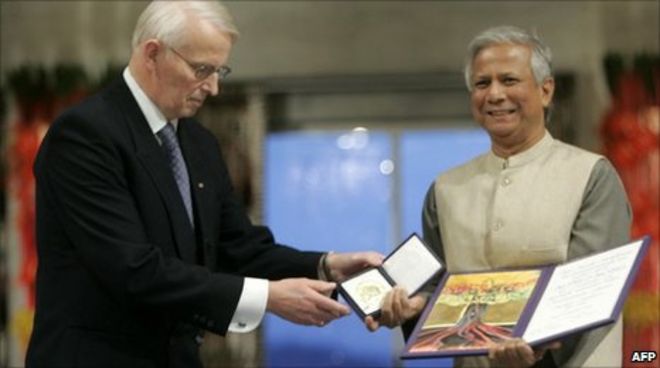
Dr. Mohammad Yunus accepting The Noble Peace Prize from BBC News

“Microcredit is used to describe small loans granted to low-income individuals that are excluded from the traditional banking system”. Providing credit, savings, insurance, and additional financial services to the poor. (MicroWorld.org) Banerjee and Duflo’s Poor Economics describes the benefits and drawbacks of micro-credits.

When arguing for microcredit, they a line with Dr. Mohammad Yunus, Grameen Bank, microfinance organization model. Yunus defines his mission as a way, “to help the poor families to help themselves to overcome poverty. It is targeted to the poor, particularly poor women.” Moreover, he clearly states microcredit is a human right that is based on ‘trust” versus legal procedures/systems.

From what I gathered from our reading, Banerjee and Duflo are for microcredit in terms of faster return on money, lower interest rates, and offer helpful support groups for members.

To justify microcredits faster return rate on money, the authors discuss a market vendor Jennifer Auma, who uses multiple rotating savings and credit associations (ROSCAs). Speaking towards Auma’s advantages of depositing a small amount of money, the authors wrote, “They don’t have fees, she could make small deposits, and on average she got access to the pot much faster than it would take her if she saved the same amount every week.”(pg. 187) Proving the authors’ stance that this form of credit helps the poor obtain money faster and avoid the costly extra fees.

Furthermore, this example touches on ROSCAs, or “merry-go-round”; which are most popular in Africa. “The ROSCA group was also a good place to ask for advice.” (187) Microcredit is used for more than just simply a savings arrangement, but it’s also a community of people helping one another to achieve their saving goals, and hold each other accountable.

The drawbacks of microcredit consist of banks being strongly against funding them, their foundation is based on trust and promotes bad saving habits.

To begin, “banks don’t like managing small accounts, largely because of the administrative costs of running them.” (pg. 187) Also, governments regulate deposit-taking institutions heavily for fear of works running away with people’s money. (188) Summarizing the authors claims against microcredits erratic funding/fees and apprehension of trustworthiness.  However, the book does state that if banks could make accounts more affordable, people, like Jennifer Auma, would be more willing to open a savings account. Lastly, the authors specified that microcredits promote a lack of self–control which leads to bad saving habits. “For example, if you want to reach a goal, joining a ROSCA where the total pot size is exactly enough to achieve that goal is a great option, because once you join, you are committed to contributing a certain amount every week or month, and when you get the pot, you have just enough to buy that thing you have looking forward to buying, and you can do it right away before the money slips through your fingers,” concluding that the lack of self–control is sufficiently serious (196)

I definitely agree with Banerjee and Duflo’s arguments for and against micro-credits and enjoy their take on arguing both sides. However, being born and raised in The United States it is hard to comprehend whether I should be for or against microcredits. I think if I living in Africa I would join at least one ROSCA group because I would love having a community of people to help and support me through that lifestyle.

2)

Microfinance activity in the Republic of Congo began in 1984 with the Central African Economic and Monetary Community(CEMAC)  2007 International Monetary Fund report. In the most recent report, there are 75 microfinance institutions making up 10.5 percent of the financial sector (pg. 62). Ironically, the Republic of Congo is in a very similar situation as described in Poor Economics. An International Monetary Fund book ‘Republic of Congo’ explains that the Congo’s financial sector is underdeveloped because banks charge such high fees for opening accounts. (Pg. 64) Quoting, “the main reasons for high lending costs are lack of competition and the risks associated with the high cost of doing business in Congo.” The Republic of Congo also ranks at the bottom of The World Bank’s Doing Business survey at number 171 out of 175. These findings allow for major micro financial opportunities.

            As far as technology, The Consultative Group to Assist the Poor’s FinDev Gateway, stated technology that shifts to instant mobile payments from required personal travel money transfer operators to accounts could double account ownership in Congo. While digital technology has the potential to make a difference in the Republic of Congo, it has a long way to go, microfinancing will be possible with the right policy and technological improvements. As far as eliminating extreme poverty by 2030, under SDG #1, Republic of Congo remains on a list of severely off-track countries (Brookings.edu)  

Blog Post #4

        By Rachel Brunts        

Part I:

  1. Find a ‘cheetah’ in your assigned country (person or organization) and show his/her/its work that helps the country move towards protection of human rights, free speech, systems of accountability, reducing poverty, etc.

Beginning in the early 1990s to present day, the Ntsiloulou rebel group, or the Ninjas, have been fighting back their political/military leader, Denis Sassou Nguesso, led by their respected leader, Frédéric Bintsamou, or Pastor Ntumi.

  IRINN article, ‘Congo-Brazzaville’s hidden war’, comments on the level of Ninja knowledge stating, “Very little is known about how they are structured and operate, and how much real control Ntumi exerts at the local level. Bereft of information, the international community has termed them, “armed elements”. To the government, they are simply “terrorists”.

The Ninjas have been fighting back their government mostly by resisting government policy, refusing to participate in pre-rigged elections, and rallying community to peacefully challenge their government officials.

After many years of back and forth conflict in December of 2017, BBC News stated, “The government and the rebel group known as the Ninjas sign a ceasefire deal.” Allowing for a more peaceful environment for trading and overall life.

  • Chapter 3 of Radelet’s Emerging Africa talks extensively about democracy building as well as discusses how one defines democracy, what is elemental and how are democracies ranked and judged. How does your country rank? Explore the following sites and answer the questions

Chapter 3 of Radelet’s Emerging Africa, explains that Radelet believes there is no universally accepted definition of democracy but defines democracies as any country that meets the Freedom House and Polity IV standards. Also, he ranks and judges each democracy by their Freedom House civil liberty score (scale 1 to 7, 1 is the best), political rights score, and average Polity IV score (scale -10 to 10, 10 is the best) Pg. 62.

According to the Think Tank Freedom House, the Republic of Congo’s 2017 freedom statue is as labeled, “not free”, ranking #27 in world freedom, on a scale of 100 being most free.  More specifically, the Congo’s freedom in the world as, “Freedom Rating 6/7, Political Rights 7/7, Civil Liberties 5/7,” 1= most free and 7= least free.

  1. What are the dangers that global democracies are facing?

After reading The Washington Post article, I’ve learned that the dangers global democracies are facing are not only occurring in sub-Saharan Africa but right here at home in the United States. As the article says, “the retreat of the United States from global leadership, coupled with the Trump administration’s weak and ambiguous commitment to democratic values at home, raises serious concerns about the near future. As democracy is undermined, the world inevitably becomes a more dangerous place.”

  • Is YALI active in your country?

Positively, YALI is active in the Republic of the Congo! A YALI member, Jean Ndongui, founded LEB CONGO, described as, “a nonprofit organization that works to “break the cycle of unemployment among young people in the Republic of the Congo by training them in leadership, entrepreneurship, and business and funding youth projects.”

  • What are current news in your country?

The most recent news I found in an AllAfrica article was a soccer game on February 19th of this year. The Republic of the Congo played a game between Zimbabwe, fighting to make the finals. The article discusses how their star player, Mario Balotelli, is most likely going to miss out on the finals due to a serious injury. While this most recent news story may not be that politically meaningful or a life-changing fact, but I am happy I found this news. This story reminds me that the Republic of the Congo is not just a poverty-stricken dictatorship, but the country just like any other. Given, their freedom may not be equal as my own; they still continue their lives in the same manner as the rest of the world, and I believe this article has provided me with a better understanding of my prior perception of the Congo.

Part II:  

  1. What are the major obstacles in raising developing countries out of poverty?

In Poor Economics by Banerjee & Duflo Ch. 6, the major obstacles in raising developing countries out of poverty is, The African ICT Explosion, fueling entrepreneurship and commerce, expanding access to finance, and strengthening health services, democracy, and governance. Thankfully to help within all of these categories this book describes how mobile phones and the internet have transcended poverty-stricken countries toward a better tomorrow. Quoting pg. 122, “These technologies are helping everyday Africans overcome some of the daunting constraints that have inhibited economic growth and poverty reduction in the past, including geographic isolation, weak infrastructure, poor information, and inefficient markets.”

Blog #3 Emerging Africa and Rep. of Congo

By: Rachel Brunts

Part I: Questions on Emerging Africa

a)         As explained in Ch. 7 of Emerging Africa, the meaning of a “Cheetah” or the cheetah generation, is a new generation of leaders and entrepreneurs rising, in the early 2000s, to government bureaucracies, civil society, organizations, and businesses. Author Steven Radelet, described this generation as, “Africa’s new generation, a nebulous yet palpable group across the continent that is seeking to redefine Africa through democracy, transparency, and a dynamic private sector, and by fostering strong connections with each other and with the rest of the world.” (126)

            Concerning the meaning of a “Big Man” or the hippo generation, were essentially a single man dictatorship in the mid-1980s. Radelet explained in Ch. 2 that, “Governance was dominated by strong-man presidents who faced few constraints on power–other than the threat of violent overthrow – and who could easily ignore inconvenient constitutional restrictions and laws with impunity.” (pg. 50)

            The hippo generation and the cheetah generation definitely refer to a different way of looking at democracy and civil society. Cheetah’s people valued and fought for their right to democracy within their government leaders; while the Hippo’s people wanted democracy, but they were suppressed by the power of one individual leader. As far as civil society, the cheetah generation had a fairly similar interest in creating a new Africa by demanding their civil rights. I believe the civil society of the hippo generation always wanted to live in a country with democracy. Although, since the government was so powerful, they were not able to achieve their rightful freedom until their government was either overthrown violently or in some cases bankrupted out of power.

b)         Reiterating Radelet’s positive view in Chapter 6 on the African ICT, he states, “Today thanks to the rapid expansion of mobile phones, Internet connections, and other forms of information and communications technology, the opportunities for technology to help lift people out of poverty and change the economic fortune of Africa have never been greater.”(pg. 110) A journal article by the International Journal of Business, Humanities and Technology on

  The Impact of Internet on African Education and Culture finds that there are both positive and negative effects the internet processes in terms of education and social networking:

It is true that the Internet has moved the continent forward by improving it businesses, educational and cultural sections; nevertheless, the halting effects have proven to be detrimental to the region’s educational and cultural aspects. If the region decides to stick to its old norms, then it will lose the benefits that the Internet age has brought.” (76)

I agree with Radelet that information and communication technologies have helped African countries grow stronger. However, at the end of the day, a poverty strikin’ country is no different than any other country; such as the United States. We are all subject to the negative and positive effects technology inevitably brings to any nation. To prove our nations similarities, the journal provided a potential solution to technology in Africa stating, “Adequate awareness about the Internet is crucial. People must be made to understand that the Internet can be a very enlightening platform, fun to surf, as well as damaging to character if inappropriately utilized.” (76)

Part II: explore one country as assigned in class

a) Yes, it is possible to get trapped in poverty. The Economic Times defines poverty traps as, “a spiraling mechanism which forces people to remain poor. It is so binding in itself that it doesn’t allow the poor people to escape it.” As described in Banerjee & Duflo’s Chapter 1, “There will be a poverty trap whenever the scope for growing income or wealth at a very fast rate is limited for those who have too little to invest but expands dramatically for those who can invest a bit more.” (pg.11) Found within the Republic of Congo Poverty Assessment Report, poverty traps in the Republic of Congo are present in all areas including geographic region, education, occupation, and household size

b)   Republic of Congo progress of SDG #1

In 2004 50.4% of the population was living below the national poverty line. As of 2011, that percentage dropped just shy of 4% at 46.5%. Personally, I do not see that as much progress toward ending poverty in all its forms.

Trading Economics data on Republic of the Congo GDP per capita PPP was used to source the following paragraph.

While the Rep. of Congo’s crude oil production increased from 347 to 307 BBL/D/1K in July of 2018 they scored 19 points out of 100 on the 2018 Corruption Perceptions Index, ranking 165th least corrupt nation of 175 countries. Also, their GDP is at -42.80%.

c) Is Human capital an issue in your country?

As defined on the Economic Help blog, “Human Capital is a measure of the skills, education, capacity, and attributes of labor which influence their productive capacity and earning potential.” Human capital is, unfortunately, an issue in the Republic of Congo. Thankfully, The World Bank stated, the “National Development Plan (2018 to 2022) lays out its intention for a change of focus to improving governance; building human capital, and diversifying the economy.”

Blog #2

By Rachel Brunts

A.

            Good news can be classified in many ways. Especially when emphasizing the factors that generate good news the answer becomes more challenging and possibly arguable. I believe Steven Radelet in Emerging Africa – How 17 Countries are Leading the Way describes Africa’s past historical events (good and bad) as the factors leading to good news in Africa. More specifically, the factors of the economic crisis, political protests, and government reform to democracy. While not all of these events are positive factors in Africa, they all can be classified as good news in Africa.

            For example, Radelet’s Chapter 2, he explains the detailed snowball effect starting during the austerity of Africa’s government and the economic crisis. Creating a peak in political protests in 1991; which pushed a government response in 1992 reforming civil liberties. Thereafter, leading to competitive political elections and African governments soon began to allow greater political rights. All in all, resulting in democracy.

            I believe these factors to be the turning point for positive growth in Africa. It a little funny to state that I would classify the complete and udder downfall of the African society would be such good news, but I believe it. Since the austerity government had nothing due to bankruptcy, they had no power over the people. Radelet quotes, “Authoritarian governments appear to have fallen not because they face more unrest but because they were unable to respond to it”. This lack of democratized power allowed counties to make their own choices and if ran responsibly, let their people live freely.

B.

Millennium Villages Project describes that “The Millennium Villages are proving that by fighting poverty at the village level through community-led development, rural Africa can achieve the Millennium Development Goals.” Also, the project suggests, “Simple solutions like providing high-yield seeds, fertilizers, medicines, drinking wells, and materials to build school rooms and clinics are effectively combating extreme poverty and nourishing communities into a new age of health and opportunity”. The article also states that the Millennium Villages support 14 sites within 10 countries for 500,000 people.  

            Supporting the Millennium Village Project, Jeffrey Sachs stated in The Age of Sustainable Development, “Eradicating poverty is the greatest global challenge facing the world today and an indispensable requirement for sustainable development”. (pg.483)

            In retrospective, a Foreign Affairs article reviews Sachs book stating, “It addresses the complicated challenge of assuring a continued rise in prosperity, particularly in the remaining poor parts of the world, while avoiding roadblocks such as the depletion of fresh water, extensive air and water pollution, the loss of biodiversity, and excessive climate change.” Overall, defining his writing as a logical yet simple examination of poverty centering the greatest global challenge.

Millennium Villages

Each individual link correlates to the source used for the given information that follows

  1. Why was that particular village chosen?

Tanzania: MV of Mbola and a new site AngloGold Ashanti (AGA); I picked this village because it has multiple MVP sites and I wanted to compare it to a single existing site.

Uganda: MV of Ruhiira; I picked this village because it is an existing MVP site and think it would be interesting to compare two divers villages.

2. What is the goal for that village?

Tanzania: Eradicate extreme poverty and hunger, Achieve universal primary education, promote gender equality and empower women, lower child mortality, improve maternal health, combat diseases, environmental stability, global development

Uganda: The village is doing well so the goal would be to continue to improve areas they are weaker in. I believe the goal would be to plant more trees on land to help with the firewood shortage. Which should also help lower population density and growth rates,   

3. What successes or failures have been recorded?

Tanzania: Successes: Businesses growing, health care centers improving, solar energy and water improvements, school attendance, students surplus, and academic performance increasing. Also, tree nurseries were planted in school to educate students on deforestation.

Failures: overgrazing and agriculture expansion decreasing land production, lack of health and education guidelines, access to antiretrovirals have decreased.   

Uganda: Successes: Number of children eating at school has increased dramatically, they were the first site to launch School 2 school program, malaria health conditions are nearly gone, and MVP has improved their water resources.  

4. What do the critics say?

Tanzania:

Uganda:

5. Look at the countries’ GDP, GNP, WDI, HDI, etc. to evaluate each village.

Tanzania: GDP:$163bil GNP: $51bil Gini: 37.8(medium) HDI: 0.531 (low,151st)  Pop: 55,572,201 Area: 55,572,201Water 6.4%

Uganda: GDP: $88bil GNP: $26bil Gini: 41.01 (medium) HDI: 0.493 (low 163rd) Po:p 41,487,965 Area: 241,038km Water: 51.39%

6. How are local, national and global issues addressed and involved?

Tanzania: They have a presidential republic. Consisting of a President, Vice President, Prime Minister, Speaker, and Chief Justice, who all address their local, national and global issues cohesively depending on their specific duties.

Uganda: They also have a presidential republic. Consisting of a President, Vice President, and Prime Minister.

7. I think Tanzania and Uganda are both conducting viable projects toward ending poverty. I have always pondered the question on how to end global poverty, but quite honestly thought it was impossible. Educating myself on the Millennium Villages Project and Millennium Development Goals has provided me with an optimistic view, agreeing with Steven Radelet, and more specifically with the future fate of TanzaniaandUganda.