Jeffrey Sachs and William Easterly both make valid arguments about ending poverty in the book Poor Economics, but they both argue opposite ways of achieving this goal. Sachs is in support providing financial aid to poor countries, whereas Easterly argues against it. Sachs argues that financial aid helps poor countries in three areas. Sachs said financial aid helps them jump-start the process of capital accumulation, economic growth, and rising household incomes. Sachs argues that financial aid is “not a welfare handout, but is an investment that breaks the poverty trap once and for all.” Poor countries are in a poverty trap where corruption causes poverty and poverty in return causes corruption. Sach’s solution to this problem is handing out financial aid for specific problems, such as malaria control that can be easily tracked and monitored. Esterly believes people living in poverty are the best ones to get themselves out of poverty. He thinks they do not need financial aid to do so.
Contrary to Sachs, Esterly says there is no such thing as a poverty trap. Poor people can escape from poverty by making a change on their own. After learning the two sides Sachs and Easterly argue, I agree with Sach’s approach where he is in favor of handing out financial aid. I think poor countries need a financial boost to get their problems fixed and their economy growing. There’s the saying, “It takes money to make money.” I believe this. Easterly argues people in poverty can make a change themselves, but I believe that many impoverished people would do what it took to live a better lifestyle if they knew how. Many people were born into impoverished families and the cycle just continues. It is not like Sachs wants to hand out money with no thought of how it gets spent. I think his approach to financial aid is strategic and efficient. His plan is strategic by giving money to specific causes and is efficient to see if it’s working by monitoring that causes progress to see if there is any progress at all. Geoffrey Gertz makes an argument that “identifying new strategies to move from successful individual projects to transformative countrywide progress in severely off-track countries” is the most important question to answer when trying to figure out how to solve poverty. I think it is important to listen to many different sides when trying to solve an issue because it might take multiple ideas, instead of one to solve a complex issue.
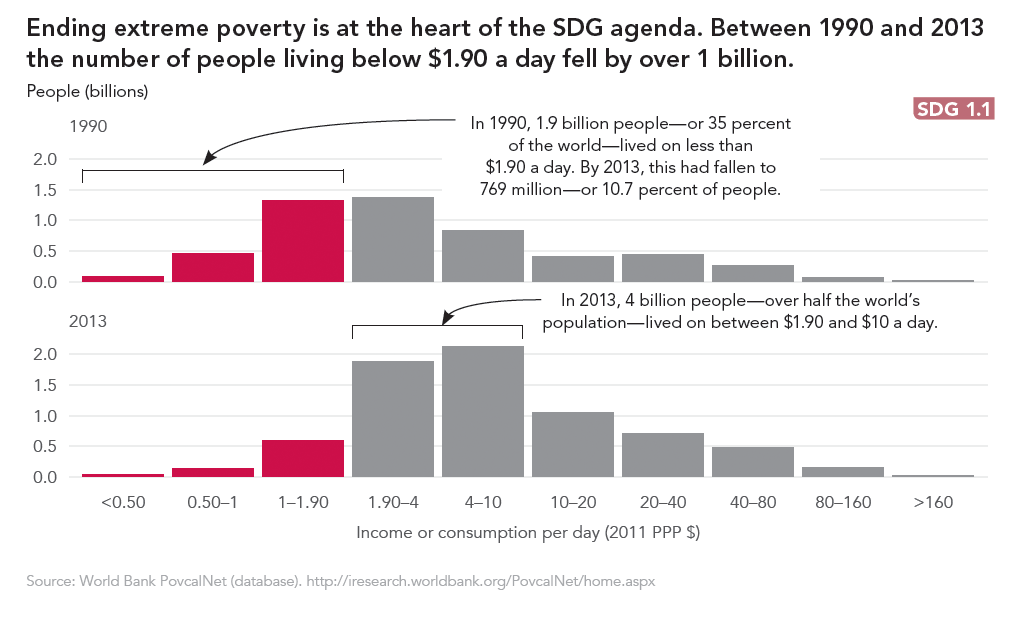
In Poor Economics, Banerjee and Duflo sufficiently address the first two sustainable development goals that include ending poverty and ending hunger everywhere. The authors addressed potential factors that could cause a country to become impoverished. They listed a few examples such as, what kind of leader is running a country and if a country has natural resources to utilize or not. Banerjee and Duflo believe that people who are living in poverty need to be healthy, educated, have food, and be able to have jobs in order to successfully escape poverty. Banerjee and Duflo say micro finances and micro-credits are policy measures that have been shown to be somewhat successful.
Micro-credits and micro finances have given people living in poverty a chance to pursue their own businesses, especially women. Micro-credits and micro finances have also allowed farmers to invest in better agricultural practices that promote sustainable growth, which also contributes to ending hunger. Banks have also been successful in the way that they have allowed the poor to effectively save their money without the fear of it being lost or stolen away. There still needs to be better healthcare and insurance plans in place so when the poor get sick they are able to seek treatments without going into debt. It is also important for the poor to be treated by hospitals if needed, so they can feel better faster and continue to work. Banerjee and Duflo think having goals that are measurable and trackable is key to accomplishing sustainable development goals.

 Case Studies in an Inter/Multicultural World