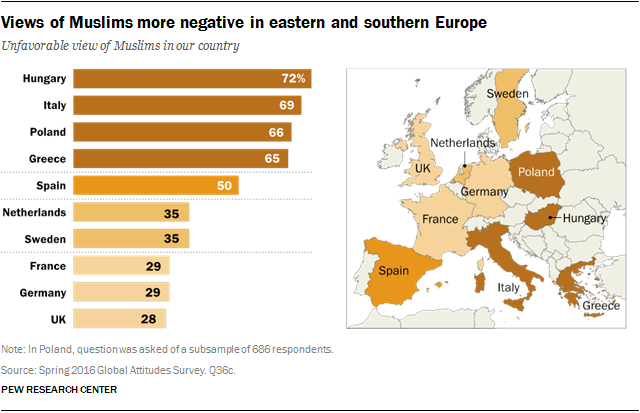
- The first myth that Justin Vaisse describes in the article titled “Muslims in Europe: A Short Introduction” is that being Muslim constitutes a fixed identity, sufficient to fully characterize a person. It is common for people to wrongfully assume that because these people are Muslim, that their religion is what makes up majority of beliefs and attitudes in society. This also constitutes in decision making. One example from the text was from an article posted by the Washington Post in an article on Migration into the EU. It was stated that “Muslims arriving from the Middle East and Africa, and Eastern Europeans moving west,” yet not all of the migrants from the region are Muslim. It was also brought to attention that Eastern Europeans would never be referred to as Orthodox or Catholic, further demonstrating the bias towards Muslims. An additional myth mentioned was that “Muslims in Europe are, in one way or the other, inherently foreign, the equivalent of visiting Middle-Easterners who are alien to the native culture.” Although Muslims have been included Muslims since the 8th century, making up 15 to 17 million people currently in the 27 European Union countries they are often looked at as only foreigners and citizens even though many categorize as European Nationality. This is an issue because Muslims differentiate vastly between European countries so it is unjust to stereotype them all as the same. Vaisse discusses the third myth that is “Muslims in Europe form a distinct cohesive and bitter group according to a 2005 Foreign Affairs article.” This myth is similar to myth two, as from country to country Muslims are not the same. The last myth stated is that “Muslims are demographically gaining on the native population,” even though there is a significant rate of intermarriage and conversions between the religion. This is a common misconception because “European birthrates are generally low, and birthrates among immigrant groups are often high.
- It is important to make a distinction between the religious and political dimensions of Islam because the political dimensions vary across countries and the extent religion; just like it does with every religion. Although the role of Islam in the public lives of Muslims plays a role in the culture, individual preferences and varying degrees of religious authority is more important. Generalizing based on the Islamic government is also a mistake that is commonly made. According to an article titled “Islam and Politics: What is a Religious Government,” it is essential to distinguish between various levels of state commitment to a specific religion. In order to have a maximized relationship between religion and politics requires “a total commitment and adherence of a state to the contents of a specific religion.” This idea goes for any religion and political affiliation, as there are always going to be varying degrees to which people chose to follow the beliefs.
- According to the book “Europe Second Religion” by Shireen Hunter, education in Europe needs to be more focused on expanding past typical categories of math, science and reading to better enable students to enter into a rewarding career field. Hunter talked about how students need to be taught life skills and to explore their own identities, along with the people around them. Understanding the people around them will enable people to become more aware of other religions around them to avoid racism that could further develop into xenophobia. Xenophobia in regards to Muslims is surrounded over the overarching issue of non-Muslim Europeans rejecting to accept Muslim individuals solely based on their culture, which is a complete disgrace. This then can turn to many Muslims feel not at home in Europe, despite being born and raised there their entire lives. In the face of challenges, one of the main inspiration that Ramadan suggests is for Muslims to stay true to themselves and core values. One of these values is faith and how it can be tied into to co-exist with other religions and cultures in a society. This is why there is a growing need for more education on religion and imprinting the idea that people need to be open-minded of other religions and cultures to bring peace amongst people who are so often discriminated against. The better understanding differing cultures and religions have for each other, the more united the country will be as a whole. The time has come to break the stereotypes associated with being Muslim and for people to start valuing these individuals as a vial part of the community.
By: Tori Travers

 Case Studies in an Inter/Multicultural World